At Up:Skill, I listened to women at very different stages of their careers.
Some were just beginning.
Some were already leading teams.
Some were changing direction.
Some were still trying to understand where they belonged.
I came into the programme thinking mostly about what I wanted to learn.
I left thinking more about what it means to become the senior person in the room.
After years of taking responsibility for projects, working with different stakeholders, and helping teams deliver, I found myself asking a more personal question:
What kind of leader am I becoming along the way?
Because the pressure changes as we move through our careers. And so does our responsibility for the people around us.
The pressure changes when you become senior
Earlier in my career, I knew what it felt like to be the junior person.
You want to do well.
You don’t want to make mistakes.
You want people to trust your work.
Sometimes, you’re trying to understand expectations that nobody has explained clearly.
You’re learning while also trying to prove that you’re capable of learning.
Later, when you become more senior, the pressure doesn’t disappear.
It changes.
You have deadlines.
You’re accountable for decisions.
People depend on you.
There are expectations from management, partners, donors and the people you supervise.
You have your own work to deliver while also trying to help other people deliver theirs.
And then I began to notice something I hadn’t thought about enough before:
My pressure can become someone else’s pressure.
When I’m worried about a deadline, that urgency can travel down the team.
When I want something done perfectly, someone else may hear that as: Don’t make a mistake.
When I’m carrying the weight of a project, I have to be careful not to make someone junior carry the weight of my anxiety, too.
That distinction has become increasingly important to me.
Listening to women at Up:Skill made me think more carefully about the experiences people carry into a room and about the kind of leader I want to be for them.
Am I creating pressure, or creating opportunity?
I still expect people to do good work.
I still care about deadlines, quality and accountability.
But I’ve become more interested in what happens between those expectations and the final result.
Can someone take ownership of something instead of only following instructions?
Can they try something they haven’t done before?
Can they present an idea?
Can they make a mistake and learn from it?
Can they see an opportunity I might not have seen?
Sometimes leadership isn’t about pushing harder.
Sometimes it’s about opening a door.
Giving someone a piece of work they’re ready to grow into.
Letting them explore an idea.
Encouraging them to speak.
Giving feedback that helps rather than simply corrects.
Recognising a contribution, even when it seems small.
As we grow into more senior roles, it’s easy to become so focused on getting things right that we forget what it felt like to be learning.
I want to remember that feeling.
Not to lower the standards I set for myself or others, but to make sure that the people working with me have room to ask questions, try new things and grow into their responsibilities.
Because the kind of support we receive early in our careers can shape the kind of support we later offer to others.
I don’t want to forget what it felt like to be on the other side.
I want to hold on to that understanding as I grow.
Motherhood made me notice something else
Becoming a mother also changed the way I think about people’s capacity.
Not their capability.
Their capacity.
Someone can be capable of doing something and still not have unlimited energy, attention or time.
There can be responsibilities outside work that nobody in the office sees.
There can be exhaustion that doesn’t appear on a CV.
There can be a difficult week that has nothing to do with someone’s commitment to their work.
I don’t think this means lowering expectations.
For me, it means becoming more curious about what a person needs in order to do good work.
Sometimes they need clearer direction.
Sometimes they need more time.
Sometimes they need encouragement.
Sometimes they need a challenge.
And sometimes they simply need someone to trust that they’re capable of growing into the opportunity.
I’m still learning how to tell the difference.
I don’t always get it right. But I want to keep asking the question rather than assuming that everyone has the same capacity, circumstances or needs.
Because supporting people doesn’t mean deciding what they can or cannot do.
Sometimes it means creating the conditions in which they can find out for themselves.
Then there is the question of recognition
As I’ve reflected on my career, I’ve also found myself wondering how much of my sense of impact depends on recognition.
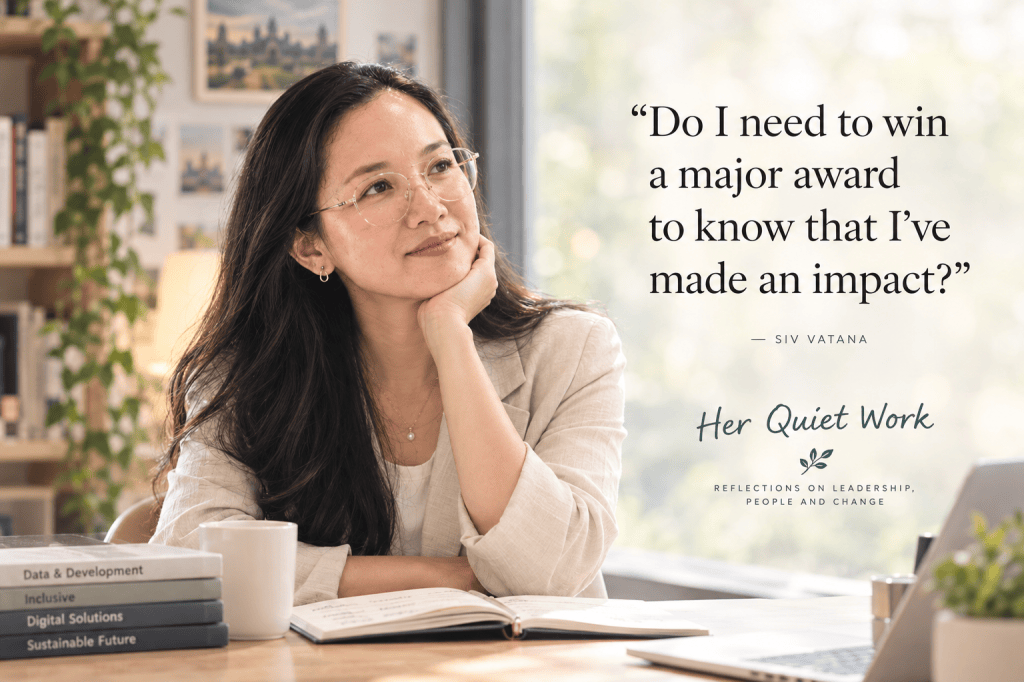
- Do I need to win a major award to know that I’ve made an impact?
- Do I need a bigger platform, a more visible title, or recognition from people outside my immediate community before the work I do can count as meaningful?
I don’t have a neat answer.
Recognition matters.
It can make someone’s work visible. It can open doors. It can create opportunities that might otherwise be difficult to reach.
I know that because being recognised at Up mattered to me.
I appreciated the opportunity to be part of the community and, later, to share my experience with another cohort. Those moments reminded me that the experiences we carry can be useful to someone else, too.
But visibility and impact aren’t always the same thing.
Some of the things that matter most in a person’s career may never become an award.
A junior colleague becomes more confident because someone gave her room to try.
Someone applies for an opportunity because another woman encouraged her.
Someone stays in a field because, at some point, she felt that she belonged there.
Someone who was once supported becomes the person who supports someone else.
You may never know the full distance that a small act of encouragement travels.
And perhaps that’s what makes these forms of impact so difficult to measure. They don’t always come with a clear starting point, a completion date or a result we can claim as our own.
Maybe impact takes longer than recognition
We’re often taught to look for evidence of impact.
Numbers.
Outputs.
Promotions.
Awards.
People reached.
Projects completed.
Those things matter, especially in the kind of work I’ve spent my career doing.
I’ve worked with data, information platforms, research and stakeholder engagement. I’ve seen the value of making information accessible and useful, and of creating opportunities for people to use it in their work.
Measurement matters. Evidence matters. Results matter.
But I’ve also come to appreciate that not everything meaningful can be captured in a report.
A conversation that changes how someone thinks.
A connection between two people that continues without you.
A person who becomes more confident because you trusted them with something.
A younger colleague who eventually becomes a leader herself.
You may not see the result immediately.
You may never see it at all.
And perhaps that’s one of the uncomfortable things about doing work intended to create change in other people and communities.
Sometimes, you don’t get to see what your contribution becomes.
I think about that when I look back at some of the connections that began around Up:Skill.
I couldn’t have known in 2023 where every relationship would eventually lead.
Some became friendships.
Some became professional connections.
Some crossed organisational boundaries.
Some continued in ways I may never fully know.
Not everything we start is ours to finish.
Sometimes our contribution is simply being there at the beginning.
Making an introduction.
Sharing an experience.
Offering encouragement.
Creating a little more room for someone else to find their way.
And then allowing the connection to become something beyond us.
The kind of senior woman I want to become
I don’t know exactly what my long-term impact will be.
I don’t know whether it will be attached to a particular project, an award, an organisation or a title.
But I’ve started to care more about a different question:
What do the people around me experience because I was there?
Did I make it easier for someone to speak?
Did I create an opportunity?
Did I help someone see something differently?
Did I make a difficult piece of work feel possible?
Did I pass pressure down simply because I was carrying it myself?
Or did I create enough space for someone else to grow?
These questions don’t belong neatly on a performance review.
There’s no award category for them.
But they’ve started to matter to me.
Maybe that’s also part of why I started Her Quiet Work.
I wanted a place to think about the parts of work that don’t always fit into a CV, a project report or a job title.
The decisions made quietly.
The people who influence us without knowing it.
The opportunities we create for someone else.
The things we learn from a room and carry somewhere else.
And the question of what all of this is ultimately for.
I still don’t know how long it takes to understand the full impact of our work. Maybe sometimes we never know.
But I’m becoming more comfortable with not having to wait for an award, a title or a larger stage to decide that the work matters.
I can pay attention to the room I’m in.
To the pressure I carry into it.
To the opportunities I open.
To the people who might need a little more space to find their voice.
And perhaps the answer isn’t to know exactly what impact I’ll leave, but to be more intentional about the impact I create along the way.
To become the kind of senior woman I once needed to see.


Leave a Reply